
Exchange dockets
Record the paper handed over at a delivery. Every balance is derived from these.
A docket is the paper record of pallets changing hands. Every balance in the system is derived from dockets — nothing else moves one.
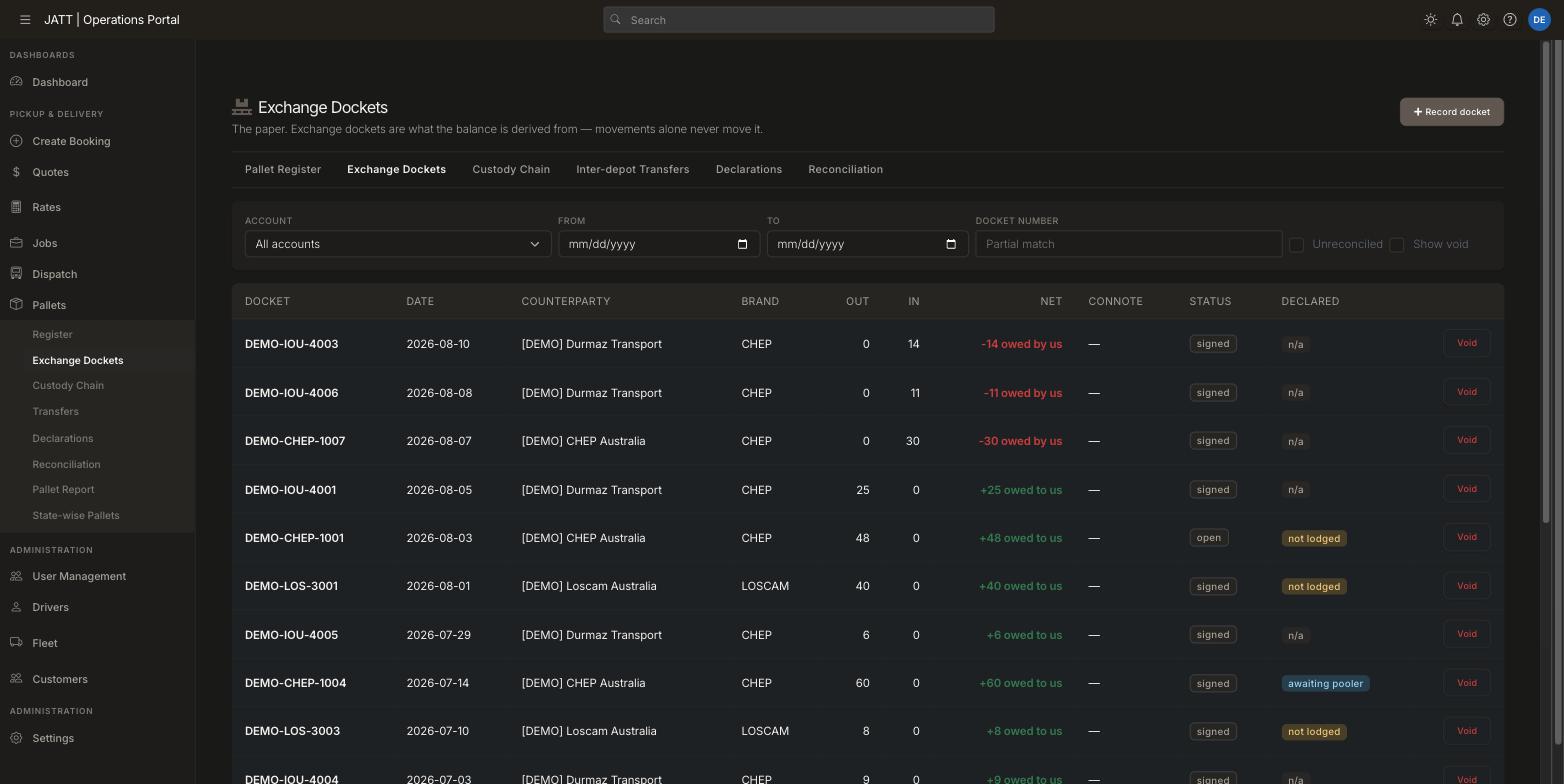
Net, signed your way
Green owed to us means pallets went out and someone else holds them. Red owed by us means they came in and we do. The sign is the direction of the debt, not of the movement.Status
open is recorded but unsigned paper; signed has the counterparty's signature. Voided dockets are hidden unless Show void is ticked.Declared
The declaration state carried from the Declarations page. n/a means nothing to lodge — an inbound docket, or equipment no pooler tracks.Void
Dockets are never deleted. Voiding leaves the row and its history in place and removes it from the balance, because the balance is derived from dockets and a deleted docket would silently change history.
Recording a docket
Section titled “Recording a docket”| Field | Notes |
|---|---|
| Docket number | From the book. |
| Date | The date of the exchange, not when you typed it. This starts the declaration deadline. |
| Account | Who the pallets went to or came from. |
| Pallets out / in | Both can be filled in — an exchange usually is. The net updates as you type. |
| Counterparty | Who signed for it. |
| Connote number | If it happened at a delivery, link it. |
The net tells you plainly which way it went: they owe us 8 or we owe them 8.
Duplicate docket numbers
Section titled “Duplicate docket numbers”CHEP does not issue duplicate docket numbers, so if you get a warning on a CHEP account, check the docket — something has been typed twice or misread.
Loscam does allow duplicates, so two of their books can legitimately carry the same number. There you will be offered Record it anyway. If you take it, the pair is flagged at reconciliation so it gets checked against the statement.
Voiding
Section titled “Voiding”Voiding removes a docket from the balance and frees its number to be reused. It needs a reason, which is kept on the record.
The custody movements stay — the pallets did physically move, and erasing that would be a lie. What voiding says is that the paper is withdrawn.
A docket that has already been reconciled with the counterparty cannot be voided. You have both agreed that balance; withdrawing your side of it unilaterally would put the two records out of step with nothing to explain why. Raise a discrepancy against the reconciliation instead.
The Declared column
Section titled “The Declared column”Shows whether the transfer has been lodged with the hire company. Amber “not lodged” and blue “awaiting pooler” both mean the pallets are still on your account — only green “accepted” stops the hire charge. See Declarations and deadlines.